
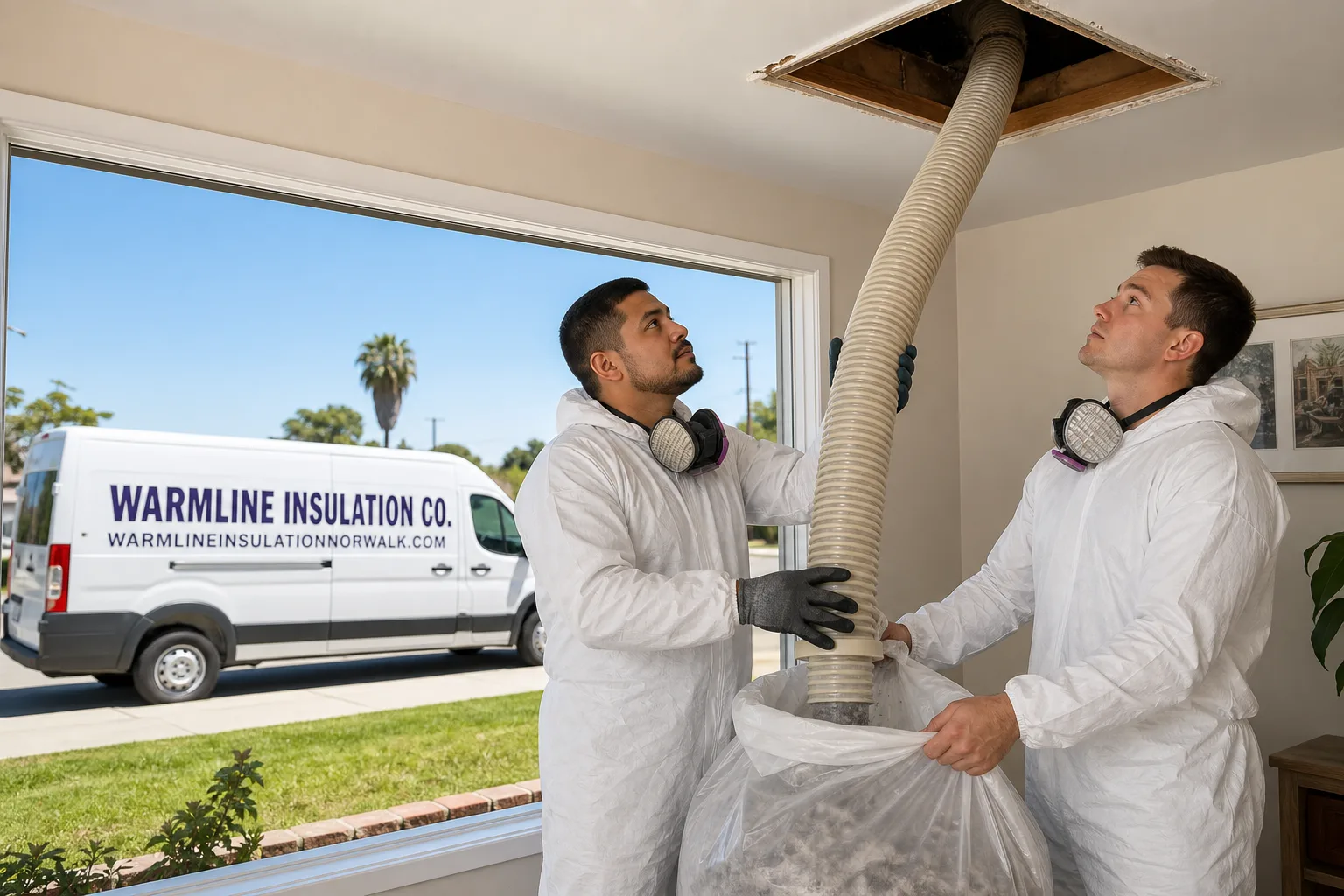
How Much Does Spray Foam Insulation Cost in Norwalk?
Our Spray Foam Insulation services in Norwalk, CA typically cost between $1,800 and $6,500 for a whole-home or major application, depending on the type of foam, the area being treated, and site conditions. Open-cell foam runs roughly $0.44-$0.65 per board foot, while closed-cell foam runs $1.00-$1.50 per board foot installed. Most Norwalk homeowners who call us for an attic or crawl space job land somewhere in the $2,200-$4,000 range once scope and material are confirmed.
If you want a fast ballpark specific to your home, our team at Warmline Insulation Co. gives free on-site estimates with upfront pricing before any work begins. Call (562) 534-9430) and a live person will pick up – no voicemail, no callback queue.
Spray Foam Insulation Cost Breakdown (2026)
The table below reflects real installed prices we see in the Norwalk market as of 2026. These ranges include labor, materials, and basic surface prep. They do not include old insulation removal, mold remediation, or permit fees if your municipality requires them.
| Application Area | Foam Type | Typical Cost Range |
|---|---|---|
| Attic (1,000-1,500 sq ft) | Open-cell | $1,800 - $3,200 |
| Attic (1,000-1,500 sq ft) | Closed-cell | $3,200 - $5,500 |
| Crawl Space Rim Joists | Closed-cell | $600 - $1,400 |
| Garage Ceiling / Walls | Open-cell or closed-cell | $900 - $2,200 |
| New Construction Walls (per 1,000 sq ft wall area) | Open-cell | $1,200 - $2,500 |
| Flat/Low-Slope Roof Deck | Closed-cell | $2,500 - $6,500 |
| Air Sealing – Targeted Gaps & Penetrations | Closed-cell (2-lb) | $400 - $950 |
| Whole-Home Bundle (attic + crawl space) | Mixed | $3,800 - $7,500 |
A few things push that needle in either direction. The biggest driver is foam density and thickness: a 2-inch lift of closed-cell hits a very different price than a 5.5-inch lift of open-cell, even on the same ceiling. Norwalk’s older housing stock – a lot of it built between 1955 and 1975 in tracts near Alondra Park and along Studebaker Road – often has narrow rafter cavities that limit thickness and change the product recommendation entirely. Accessibility is another real factor; tight attics with low clearance or crawl spaces under older homes near Orr and Day Streets add labor time that shows up in the final number. Material costs have also shifted since 2024, partly due to supply chain adjustments on the chemical components used in Icynene and Demilec products, which is why 2025 quotes may not match 2026 actuals.
One thing that does not change: we give you the number before we start, and it does not grow after the job is done. That is what upfront pricing means at Warmline.
What Affects Spray Foam Insulation Pricing in Norwalk
No two homes quote the same way, even on the same street. These are the six factors that most consistently move the price in the Norwalk market.
- Open-cell vs. closed-cell foam: Open-cell (0.5-lb density) is softer, vapor-permeable, and less expensive per board foot – good for interior attic rafters and interior walls. Closed-cell (2-lb density) is rigid, moisture-resistant, and structurally reinforcing – necessary for crawl spaces, rim joists, flat roofs, and anywhere exterior moisture is a concern. In Norwalk, where marine layer humidity from the coast reaches inland most mornings from May through August, closed-cell is often the right call for exterior-facing assemblies.
- Square footage and thickness: Spray foam is priced by the board foot (one square foot, one inch thick). A job that requires R-13 costs about half as much per square foot as one requiring R-38, because thickness – not just area – drives material volume. Norwalk follows California’s Title 24 requirements, which specify minimum R-values by climate zone. Norwalk sits in California Climate Zone 8, and current Title 24 standards require at least R-19 for attic floors and R-13 for wood-framed walls – these floors set a real lower bound on how thin an application can be.
- Accessibility and site conditions: Attics under a 1960s ranch home near Norwalk Boulevard with 18 inches of clearance take longer to work in than a newer two-story near Carmenita Road with a full walk-up attic. Labor time is real cost, and tight access adds it. Crawl spaces under older homes on the southeast side of Norwalk – near Excelsior Drive and near the San Gabriel River basin – are often damp and low, which adds both protection requirements for our crew and surface prep time.
- Existing insulation removal: If we need to pull out old, compressed fiberglass batts or wet blown-in before applying foam, that is a separate labor and disposal cost. Our Spray Foam Insulation in Norwalk service page covers what’s typically included in each scope. Removal in an average Norwalk attic adds roughly $400-$900 to the project, depending on depth and material type.
- Number of lifts required: Closed-cell foam cannot be applied too thick in a single pass – heat from the exothermic reaction becomes a risk if a single lift is too deep. Multiple lifts mean re-staging, re-masking, and additional cure time. For high-R applications like a fully conditioned attic, this is often unavoidable and adds to the job time and cost.
- Local permit requirements: The City of Norwalk does not universally require a building permit for insulation replacement in existing homes, but spray foam on a roof deck, structural walls, or as part of a remodel may trigger permit review through the Los Angeles County Building and Safety division. When permits apply, add $150-$500 to the project cost. We help homeowners figure out what is and is not required before the quote is finalized.
Open-Cell vs. Closed-Cell: Which One Is Right for Your Norwalk Home?
This is probably the most common question we field, and the answer genuinely depends on where in the house you are installing and what problem you are trying to solve.
Open-Cell Foam
Open-cell foam expands aggressively – typically 100 times its liquid volume – which makes it excellent at filling irregular cavities, around wiring, pipes, and blocking gaps in old framing. Because it is vapor-permeable, it allows walls to dry if they get wet, which is an advantage in interior applications. At roughly $0.44-$0.65 per board foot installed, it is the more accessible choice for large-area jobs like attic rafter bays or interior wall cavities. Icynene open-cell products are among the most used in Southern California applications for exactly this reason: they hit the required R-value per inch for Climate Zone 8 without excessive material cost.
Closed-Cell Foam
Closed-cell foam is denser, harder, and acts as a class II vapor retarder on its own – meaning it slows moisture movement through assemblies. At $1.00-$1.50 per board foot, it costs more, but it also delivers higher R-value per inch (around R-6.5 per inch vs. R-3.7 for open-cell), which matters when you have limited cavity depth. For Norwalk homes with shallow attic rafters, flat roof decks, or crawl spaces that take on ground moisture, closed-cell is frequently the right material. Demilec and Johns Manville both manufacture closed-cell products with strong track records in Southern California’s temperature swings – from summer highs in the mid-90s in the inland areas of Norwalk down to 45-degree nights in January.
The short version: open-cell for interior, vapor-open assemblies where you have space; closed-cell for exterior-facing assemblies, moisture-exposed areas, or anywhere cavity depth is limited. When you are not sure, a home energy audit is the fastest way to get a clear recommendation before you spend money on materials.
Spray Foam Insulation and California Title 24 in Norwalk
If you are doing any work that triggers a permit in Norwalk – a room addition, a garage conversion, a re-roof with insulation – you will need to meet California’s Title 24 Building Energy Standards. For Climate Zone 8 (which covers Norwalk and much of the 562 area code), the current minimums are:
- Attic / ceiling: R-38 (prescriptive path)
- Wood-framed walls: R-13 minimum
- Raised floor: R-19
- Flat roof / low-slope: R-19 continuous or equivalent
Closed-cell foam at 3 inches hits approximately R-19.5, which satisfies the raised floor and some wall requirements in a single material with no additional batts needed. Hitting R-38 in an attic with spray foam alone is possible but expensive; a hybrid approach – closed-cell air sealing at the attic floor plane combined with blown-in insulation on top – is often the most cost-effective path for Norwalk homeowners who are trying to pass Title 24 compliance without over-spending on foam where blown-in does the job just as well.
Our crew works with this combination regularly. The air sealing layer handles the infiltration problem; the blown-in handles the thermal resistance. You get a compliant assembly without paying closed-cell rates for every inch of depth.
How to Save on Spray Foam Insulation in Norwalk
Spray foam is not the cheapest insulation per square foot, but it is often the most cost-effective over a 10-15 year horizon because it does not compress, settle, or need replacement. That said, there are real ways to reduce the upfront number without compromising results.
Bundle Services
The single most effective way to reduce cost per square foot is to bundle multiple scopes into one visit. If you need attic air sealing and spray foam for your crawl space rim joists, doing them together eliminates a second mobilization, a second masking setup, and a second crew dispatch. At Warmline, we handle ten insulation and home-performance services under one roof, which means you are not coordinating separate contractors or paying separate trip fees for related work. A whole-home bundle – attic foam plus crawl space encapsulation, for example – typically saves $300-$600 compared to booking the same scopes separately.
Get a Home Energy Audit First
This sounds counterintuitive – pay for an audit before you pay for insulation? – but it consistently saves money. An audit tells you exactly where the heat is moving and where the air is leaking. In Norwalk homes, we often find that the biggest thermal loss is not in the walls at all; it is through an uninsulated attic hatch, leaky recessed lights in the ceiling plane, or a completely uninsulated HVAC plenum in the attic. If you foam the walls without addressing those, you have spent money and barely moved your energy bill. The audit makes every other service smarter and more targeted.
Time the Job Strategically
Spray foam contractors in the Los Angeles metro tend to be busiest from October through February, when homeowners feel the cold nights and call for help. Late spring – April through June – is typically a slower period, and scheduling then sometimes opens up better pricing or faster availability. We are straightforward about this when customers ask.
Use the Standing Discounts
Warmline’s standing discounts are real and do not expire:
- $50 Off Any Repair Over $250 – applies to repair and remediation scopes within insulation work.
- $89 Seasonal Tune-Up – a focused inspection and performance check of your insulation and air sealing system.
- 5% Senior & Veteran Discount – permanent, no paperwork tangle, applied at time of invoice.
Check for Utility Rebates
Southern California Edison and SoCalGas both periodically offer rebate programs for insulation upgrades that meet specified R-value minimums. These programs change annually, but a homeowner in Norwalk who upgrades from below R-19 to R-38 in the attic may be eligible for rebates ranging from $100 to $500 depending on program timing. We do not administer these programs, but we can provide the documentation – square footage, material type, R-value achieved – that the utility companies require for submission.
To get a free estimate with upfront pricing and no obligation, call us at (562) 534-9430. A live person answers every time.
Why Spray Foam Is Particularly Useful for Norwalk Homes
Norwalk’s housing stock skews older. A large share of single-family homes in the city were built between 1945 and 1975 – the postwar and early suburban boom that extended southeast from Los Angeles. Those homes were built with minimal insulation by modern standards, with wall cavities that may have been filled with deteriorated kraft-faced fiberglass batts or nothing at all, and attic floors that may have three or four inches of old blown-in that has settled and compressed to below R-10.
Spray foam addresses two problems that older Norwalk homes typically have at once: air infiltration and thermal resistance. Batt insulation slows heat transfer but does nothing for air movement – and in a 1960s ranch home near Marquardt Avenue or on the east side near Elaine Avenue, the framing gaps, top-plate holes, and recessed light cans are often the bigger energy loss than the insulation value itself. Spray foam seals and insulates in a single application, which is why homeowners in Norwalk who switch from old batts to foam frequently report noticeable comfort changes within days, not seasons.
There is also a moisture angle specific to this part of Los Angeles County. The morning marine layer that pushes inland through the summer months keeps outdoor humidity elevated for the first few hours of most days from May through September. Homes without adequate vapor control in their crawl spaces or at their roof planes can accumulate moisture over time, which compromises insulation performance and, eventually, wood framing. Closed-cell foam at critical junctions – rim joists, roof deck edges, around HVAC penetrations – functions as both insulation and a vapor retarder, addressing both problems in a single material.
What the Installation Process Looks Like
If you have never had spray foam installed, it helps to know what to expect so there are no surprises on job day.
Before our crew arrives, we will have confirmed the scope, material type, and price in writing. On the day of the job, our background-checked technicians show up in uniform, do a brief walkthrough with you to confirm scope and access, then begin masking surfaces adjacent to the work area – because spray foam overspray is permanent, this masking step is taken seriously. The area being sprayed needs to be clear of stored items, and occupants (including pets) should plan to be out of the treated space during application and for 24 hours afterward while the foam cures. This is a safety requirement, not a preference – the chemical components of spray foam produce fumes during the reaction phase that require ventilation before reoccupancy.
Most residential spray foam jobs in Norwalk are completed in a single visit. A focused rim joist application might take three to four hours. A full attic with air sealing prep can run six to eight hours depending on access and square footage. We do not leave a job half-done and schedule a return; the whole scope is finished in one mobilization whenever the project allows it.
After the foam has cured, we do a walkthrough with you, confirm the work matches the scope, and explain what you should and should not expect in the weeks following installation (slight off-gassing smell in the first few days is normal; any visible gaps or thin spots are covered by our 90-Day Done Right Promise).
FAQs – Spray Foam Insulation Cost in Norwalk
How much does spray foam insulation cost per square foot in Norwalk, CA?
Installed cost in the Norwalk market runs approximately $0.44-$0.65 per board foot for open-cell and $1.00-$1.50 per board foot for closed-cell. A board foot is one square foot at one inch of thickness, so a 1,000 square foot attic treated to three inches of open-cell foam would be 3,000 board feet – roughly $1,320 to $1,950 in material and labor at those rates, before mobilization and any prep work. For a firmer number specific to your home, call (562) 534-9430 for a free estimate.
Is spray foam worth the cost compared to blown-in or batt insulation?
Spray foam costs more upfront – typically 2 to 4 times more per square foot than blown-in fiberglass or cellulose. Whether it is worth it depends on what you are trying to solve. If the primary problem is air infiltration (drafts, uneven room temperatures, high bills despite adequate R-value), spray foam addresses that directly in a way blown-in cannot. If you need to hit a high R-value in a large open attic floor, blown-in is often more cost-effective for the thermal resistance alone. Many Norwalk homeowners end up with a hybrid approach: closed-cell spray foam for air sealing at penetrations and rim joists, blown-in for the bulk of the attic floor. That combination often delivers 90% of the performance benefit at 60-70% of the all-foam cost.
How long does spray foam insulation last in a Norwalk home?
Properly installed spray foam – whether open or closed-cell – has an indefinite service life when protected from UV exposure and physical damage. It does not compress, settle, or absorb water (closed-cell) the way fiberglass batts do. Homes in Norwalk that had spray foam installed in the early 2010s are still performing at spec today. The material does not need periodic replacement; the investment is effectively permanent once it is in place. That longevity is a large part of why the higher upfront cost pencils out over a 15-20 year ownership horizon.
Do I need a permit for spray foam insulation in Norwalk?
For most standard insulation upgrades in existing homes – replacing attic insulation, sealing crawl space rim joists, insulating a garage ceiling – the City of Norwalk and Los Angeles County Building and Safety do not require a building permit. However, if the work is part of a remodel, a room addition, an ADU conversion, or a re-roof that triggers plan check, then Title 24 energy compliance documentation is required as part of the permit package. Spray foam on a structural assembly (like a roof deck) may also require an inspection in some project types. We flag this during the estimate so there are no surprises at the end of the job.
Can spray foam insulation lower my energy bill in Norwalk?
Yes – the data from Southern California Edison service territories consistently shows that air sealing and insulation upgrades reduce HVAC energy use. The actual reduction depends on your starting condition, but Norwalk homeowners upgrading from minimal or degraded attic insulation to a properly air-sealed and insulated system frequently see HVAC energy reductions in the range of 15-30% during peak summer cooling months. Homes near the 91 or 605 interchange corridors – where urban heat island effects are noticeable – tend to see the upper end of that range because the outdoor-to-indoor temperature differential is larger. A home energy audit gives you a baseline measurement before you invest, so you can estimate the actual expected return rather than guessing.
How long does spray foam installation take?
Most Norwalk residential jobs are finished in a single visit. A targeted application – rim joists, attic hatch, specific penetrations – typically runs 2 to 4 hours. A full attic application with proper air sealing prep runs 5 to 8 hours depending on square footage and access conditions. After the foam is applied, the space needs 24 hours before reoccupancy for full cure and ventilation. We schedule around your availability and confirm the timeline in writing before the job starts.
Why Norwalk Homeowners Work with Warmline Insulation Co.
We have been doing this work since 2011. Neil Ashford built Warmline on a straightforward premise: homeowners deserve a licensed, insured specialist who tells them exactly what they need, exactly what it costs, and then actually delivers on both. No upsell theater, no vague estimates that balloon at invoice time.
The 90-Day Done Right Promise puts that in writing. If something about the work is not right – thin spots, missed areas, anything that does not match the agreed scope – we come back and make it right at no additional cost. Most of our competitors do not offer that in writing. We do because we are confident in the work our crew does.
Neil Ashford and the Warmline team use materials from Owens Corning, Icynene, Demilec, Johns Manville, and other manufacturers who have earned their standing in the industry through performance data, not marketing. When we recommend a product, it is because it is the right material for the application, not because it is the least expensive option to source.
Our technicians are background-checked and show up in uniform. Phones are answered by a live person 24 hours a day. Pricing is given upfront before any work begins. These are not things we treat as optional extras – they are the baseline of how we operate in Norwalk and every community we serve.
Key Takeaways
- Spray foam in Norwalk runs $0.44-$0.65/board foot for open-cell and $1.00-$1.50/board foot for closed-cell, installed.
- Whole-home jobs typically fall between $1,800 and $6,500, with most Norwalk attic projects landing in the $2,200-$4,000 range.
- Norwalk is in California Climate Zone 8, where Title 24 prescribes R-38 for attics and R-13 for walls – foam thickness must be sized accordingly.
- Closed-cell foam is the better choice for moisture-exposed assemblies (crawl spaces, roof decks, rim joists); open-cell is appropriate for interior, vapor-open applications.
- Bundling spray foam with attic air sealing or crawl space encapsulation in one visit typically saves $300-$600 versus booking separately.
- A home energy audit before you spend on materials ensures you address the right problems in the right order.
- Warmline offers three standing discounts: $50 Off Any Repair Over $250, an $89 Seasonal Tune-Up, and a permanent 5% Senior & Veteran Discount.
- All work is backed by the 90-Day Done Right Promise – in writing.
Get Your Free Estimate
If you are trying to figure out what spray foam insulation will actually cost for your Norwalk home, the fastest path is a free on-site estimate where we look at the actual space, confirm the right material, and give you an exact number before anything is scheduled. Call (562) 534-9430 – a live person answers every call, any time of day. Estimates are free, pricing is upfront, and most jobs are done in a single visit.
Pricing reflects the Norwalk market as of 2026. Warmline Insulation Co. offers free estimates – call (562) 534-9430.
Written by Neil Ashford, Owner at Warmline Insulation Co., serving Norwalk, CA since 2011.
What Our Customers Say
"Solid work on the spray foam in the rim joists and the garage ceiling. Scheduling slipped a day because of rain, which they called about ahead of time. Would use them again."
- Tom Reinholt"Injection foam in the walls of our 1950s house - no drywall demolition, just small holes patched and painted the same day. The street noise in the front bedroom is half what it was."
- Yasmin Farah"Upstairs was ten degrees hotter than downstairs every summer. They pulled the attic to bare joists, air-sealed every can light and top plate first, then blew it to R-49. First August in this house where the bedrooms and the living room read the same on the thermostat."
- Marcus Hale